
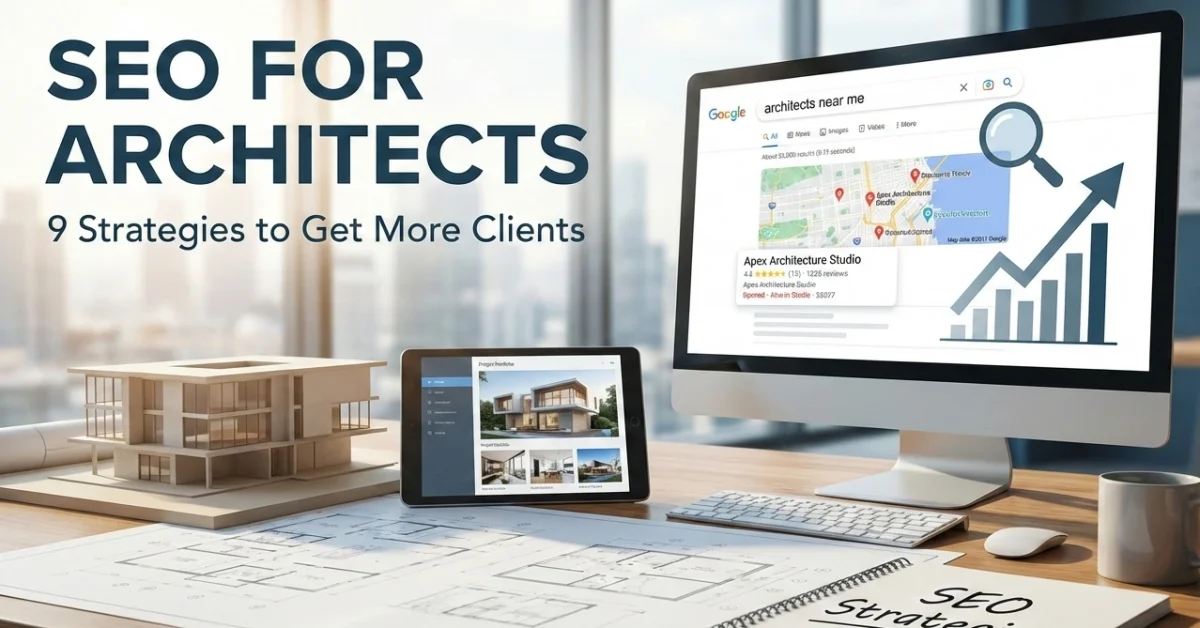
Most architecture firms rely solely on referrals, missing thousands of potential clients searching online. Here’s how to fix that with search engine optimization built specifically for architects.
93%
of online experiences begin with a search engine
When potential clients need an architect, where do they look first? For the vast majority, the answer is Google. They search for terms like “residential architect near me” or “modern home designer in [city]”-and the firms that appear at the top win the project.
Yet most architecture firms have beautiful portfolio websites that no one ever finds. They’re invisible to the very clients actively searching for their services. The solution? SEO for architects-a strategic approach to making your firm visible exactly when potential clients are looking for you.
This guide covers nine actionable strategies specifically designed for architecture firms. Whether you’re a solo practitioner or managing a large firm, these techniques will help you generate more qualified leads through organic search. For a comprehensive overview of how all SEO elements work together, see our complete SEO chart guide.
What Is SEO for Architects?
Search engine optimization (SEO) is the practice of improving your website so it ranks higher in search results for relevant terms. For architects, this means appearing when someone searches for services you offer-like “commercial architect,” “sustainable home design,” or “architect in Los Angeles.”
What makes SEO different for architects? Your industry has unique characteristics that affect strategy:
- Visual portfolios matter. Architecture is inherently visual, so image optimization and portfolio presentation play a crucial role.
- Local visibility is critical. Most clients search for architects within their geographic area, making local SEO essential.
- Trust signals are paramount. Architecture projects involve significant investment, so demonstrating credibility through reviews, credentials, and awards influences rankings and conversions.
- Long decision cycles. Clients research extensively before choosing an architect, meaning your content needs to answer questions throughout their journey.
The opportunity is substantial. In the US alone, architecture-related terms receive hundreds of thousands of searches monthly. The top three results capture over 54% of all clicks-and the first position alone often gets 30% or more. Understanding search engine positioning is essential to capturing this traffic.
Why Architects Need SEO in 2025
Referrals have built many successful architecture practices. But relying solely on word-of-mouth creates vulnerability-when referral sources dry up or slow down, so does your pipeline.
SEO diversifies your lead generation with several compelling advantages:
Clients are searching. Research shows that 46% of Google searches have local intent. People aren’t just browsing-they’re actively looking for services near them. When someone types “architects near me,” they’re ready to take action.
Credibility through visibility. Ranking on the first page-especially in the top three positions-signals credibility. Potential clients perceive high-ranking firms as established and trustworthy, even before reading a single word on your site.
Cost-effective over time. Unlike paid advertising that stops generating leads the moment you stop paying, SEO compounds. The content and optimizations you create today continue working months and years later, reducing your cost per lead over time.
📊 The 2025 Factor: AI Overviews
Google’s AI Overviews are changing how clients discover architects. These AI-generated summaries appear at the top of search results for many queries, pulling information from authoritative sources. Firms with well-structured, comprehensive content are more likely to be cited in these overviews-giving them visibility even above traditional search results. Working with an experienced SEO strategist can help you optimize for these new search features.
Reach clients earlier in their journey. SEO lets you connect with potential clients while they’re still researching-reading about the design process, understanding what architects cost, or learning about different architectural styles. By the time they’re ready to hire, they already know your firm.
9 Proven SEO Strategies for Architects
These strategies are ordered by impact and ease of implementation. Start with the first few if you’re new to SEO, then progressively add more sophisticated tactics as you build momentum.
1. Keyword Research for Architecture Services
Effective SEO starts with understanding what potential clients actually search for. Keyword research reveals the exact phrases people use-and their search volume and competition level.
For architects, focus on three types of keywords:
- Service-based keywords: “residential architect,” “commercial architecture firm,” “interior architect”
- Location-modified keywords: “architect in Denver,” “San Francisco architecture firm,” “home designer near me”
- Project-type keywords: “modern home design,” “historic renovation architect,” “sustainable building design”
Use tools like Google Keyword Planner (free), Ahrefs, or SEMrush to identify opportunities. Look for keywords with reasonable search volume (50+ monthly searches) and lower competition where you can realistically rank. For quick bulk keyword generation, try our free keyword generator tool.
Pro tip: Check the “Searches related to” section at the bottom of Google’s results page. These suggestions reveal long-tail variations people actually search for-often with less competition than broader terms.
2. Optimize Your Google Business Profile
For local visibility, your Google Business Profile (GBP) is arguably more important than your website. It determines whether you appear in Google’s Local Pack-the map results that appear for location-based searches.
- Claim and verify your listing at business.google.com
- Complete every section: services, hours, attributes, description
- Upload high-quality photos of completed projects (Google rewards fresh visual content)
- Add your service areas if you work beyond your office location
- Respond to all reviews-positive and negative-professionally
- Post updates regularly about new projects, awards, or industry insights
The data supports this priority: 56% of actions on local business listings result in website visits, and 24% result in direct phone calls. Getting into Google’s three-pack of local results dramatically increases your visibility for “architect near me” searches. For a complete guide on maximizing your profile, read our article on generating organic visits for your Google Business Profile.
3. Create Dedicated Service Pages
Many architecture firms make a critical mistake: listing all services on a single page. This dilutes your SEO potential because each page can only effectively target a limited number of keywords.
Instead, create individual pages for each service you offer:
- Residential architecture
- Commercial architecture
- Interior design services
- Renovation and restoration
- Sustainable/green building design
- Master planning
Each page should target specific keywords (including location modifiers), include relevant project examples, feature client testimonials specific to that service, and have clear calls-to-action. For guidance on structuring these pages effectively, see our guide on what to include on service pages.
A page titled “Residential Architect in Austin, TX” targeting that exact phrase will outrank a generic “Services” page every time-because it directly matches what potential clients are searching for.
4. Optimize Project Portfolio Pages
Your portfolio showcases your best work-but are those pages working for SEO? Most architecture portfolio pages are image-heavy with minimal text, missing significant ranking opportunities.
Transform each project into an SEO asset:
- Keyword-rich titles: “Modern Lake House Design | Austin, TX” instead of just “Lake House”
- Detailed descriptions: Write 300-500 words covering design philosophy, challenges overcome, materials used, and client objectives
- Location and project type: Naturally incorporate geographic and categorical terms
- Optimized images: Every image needs descriptive alt text like “Open-concept living room with floor-to-ceiling windows by [Firm Name]”
These optimized project pages can rank for long-tail searches like “modern lake house architecture” or “custom home design Austin”-bringing in highly qualified traffic from people searching for exactly what you’ve built.
5. Master On-Page SEO Fundamentals
On-page SEO refers to optimizations you make directly on your website pages. These fundamentals apply to every page on your site:
- Title tags are the clickable headlines in search results. Keep them under 60 characters and include your primary keyword plus location when relevant. Example: “Residential Architect in Seattle | [Firm Name]”
- Meta descriptions appear below title tags in search results. Write compelling copy under 160 characters that includes your keyword and encourages clicks. Think of it as ad copy for your search listing.
- Header hierarchy structures your content for both users and search engines. Use one H1 per page (your main title), then H2s for major sections and H3s for subsections. Include keywords naturally in these headers.
- URL structure should be clean and descriptive. Use “/services/residential-architecture/” rather than “/page-id-12345” or “/services.html?type=residential”.
- Internal linking connects related pages on your site, helping search engines understand your content structure and distributing ranking authority. Link from service pages to relevant project examples, from blog posts to service pages, and so on. For a visual breakdown of all SEO elements, see our SEO chart guide.
6. Build Local Citations and NAP Consistency
Citations are online mentions of your business-typically in directories. They’re a key ranking factor for local SEO, but only if your information is consistent everywhere.
NAP stands for Name, Address, Phone number. This information must be identical across every platform-including formatting. “123 Main Street, Suite 100” and “123 Main St. #100” are treated as inconsistencies.
Priority citation sources for architects:
- General directories: Yelp, Better Business Bureau, Yellow Pages
- Professional associations: AIA directory, local architect associations
- Industry platforms: Houzz, ArchDaily, Architizer
- Local directories: Chamber of commerce, local business associations
Start by auditing your existing citations using a tool like Moz Local or BrightLocal. Fix any inconsistencies before building new citations. For more on local SEO best practices, see our local SEO landing page examples.
7. Create Educational Content
Content marketing-particularly blogging-serves multiple SEO purposes: it targets long-tail keywords, demonstrates expertise, earns backlinks, and keeps your site fresh.
Effective content ideas for architects:
- Process-oriented: “What to Expect When Working with an Architect,” “The Architecture Design Process Explained”
- Decision-guidance: “How to Choose an Architect for Your Custom Home,” “Questions to Ask Before Hiring an Architecture Firm”
- Educational: “20 Design Considerations for School Buildings,” “Understanding Sustainable Architecture”
- Local-focused: “Architecture Trends in [City],” “Historic Preservation Requirements in [Region]”
These topics match what potential clients search for early in their journey. By answering their questions comprehensively, you position your firm as the obvious choice when they’re ready to hire.
Publishing consistently matters more than volume. One well-researched, comprehensive article per month outperforms four thin posts. Content is a key element that an SEO strategist can help you plan and execute effectively.
8. Earn Quality Backlinks
Backlinks-links from other websites to yours-remain one of Google’s strongest ranking signals. For architects, there are natural opportunities to earn these links:
- Publication features: Get projects featured in ArchDaily, Dezeen, Dwell, or local publications
- Award submissions: Submit to design competitions-winners get linked extensively
- Guest articles: Contribute expertise to industry blogs, local business sites, or real estate publications
- Community involvement: Sponsor local events, participate in design charettes, teach workshops-each often includes a link to participants
- Supplier relationships: Brands you specify may feature your projects in their portfolios
Quality dramatically outweighs quantity. One link from a respected architecture publication like ArchDaily provides more ranking power than dozens of links from low-quality directories.
9. Optimize Technical SEO and Site Speed
Technical SEO ensures search engines can efficiently crawl, understand, and index your site. Architecture websites face particular challenges here because portfolios tend to be image-heavy.
- Mobile optimization: Over 60% of searches happen on mobile devices. Your site must work flawlessly on phones-test using Google’s Mobile-Friendly Test.
- Page speed: Large portfolio images often slow architecture sites. Compress images without sacrificing quality, use modern formats (WebP), implement lazy loading, and consider a content delivery network (CDN). Test with PageSpeed Insights.
- Core Web Vitals: Google’s user experience metrics-Largest Contentful Paint (LCP), First Input Delay (FID), and Cumulative Layout Shift (CLS)-are ranking factors. Address any issues flagged in Google Search Console.
- Security: HTTPS is required for rankings and user trust. Ensure your SSL certificate is properly installed and all pages load securely.
- Indexation: Submit an XML sitemap through Google Search Console and ensure your robots.txt file isn’t blocking important pages.
How to Measure Your SEO Success
SEO is a long-term investment-you need to track progress to understand what’s working. Focus on these key metrics:
Google Search Console (free) shows your impressions, clicks, click-through rate, and average position for specific keywords. Monitor which queries drive traffic and how positions change over time.
Google Analytics reveals your organic traffic volume, which pages attract visitors, user behavior, and-if configured-goal completions like contact form submissions.
Keyword ranking tools like Ahrefs, SEMrush, or even free options like Ubersuggest let you track specific keyword positions over time.
Key metrics to watch:
- Organic traffic growth (month-over-month, year-over-year)
- Keyword rankings for target terms
- Click-through rate from search results
- Leads generated from organic traffic
- Local pack appearances and GBP actions
⏱️ Timeline Expectations
SEO is a marathon, not a sprint. Expect 3-6 months before seeing meaningful movement on competitive keywords. Local SEO often shows faster results-sometimes within weeks for less competitive markets. The firms that succeed are those that commit to consistent effort over time.
Frequently Asked Questions
How long does SEO take for architecture firms?
Most architecture firms see initial improvements in 3-6 months, with significant results in 6-12 months. Local SEO often shows faster results than national rankings because there’s less competition for location-specific searches.
How much does SEO cost for architects?
SEO costs vary from DIY (free plus time investment) to $1,500-$5,000 per month for professional services. Many firms start with local SEO basics like Google Business Profile optimization before scaling to comprehensive campaigns.
Can I do SEO myself or do I need an agency?
Many architects successfully handle basic SEO themselves-especially local SEO and content creation. Agencies add value for competitive markets, technical optimization, and when you need faster results or lack time for ongoing SEO work.
What’s the most important SEO factor for architects?
For most architecture firms, Google Business Profile optimization delivers the fastest ROI. It directly impacts local visibility where most clients search, and it’s completely free to set up and maintain.
Should architects focus on local or national SEO?
Start with local SEO-it’s less competitive and targets clients in your service area who are actively looking for architects nearby. Expand nationally only after dominating local searches and if your firm serves clients beyond your immediate region.
Start Ranking Higher Today
SEO transforms your architecture firm’s website from a digital portfolio into a client-generating asset. While the strategies above require effort, they compound over time-unlike paid advertising that stops working the moment you stop paying.
If you’re just getting started, focus on the highest-impact, lowest-effort strategies first: optimize your Google Business Profile, ensure NAP consistency across directories, and create dedicated service pages with location-specific keywords.
Remember that SEO rewards consistency and patience. The firms that commit to ongoing optimization-publishing content, earning backlinks, improving technical performance-build an increasingly powerful competitive advantage that’s difficult for competitors to replicate.
Your potential clients are searching for architects right now. The question is whether they’ll find you-or your competitors.